Tan or thin patches in Kentucky bluegrass can come from dry soil, insects, disease, or mowing too short. They often look alike, so check before you treat.
Utah State University (USU) Extension says most brown lawns in hot weather come from drought stress,1 so check for a watering problem first. If water isn't the cause, check for insects next, and send a sample to a lab if you still suspect disease.
This guide covers five steps: note where and when the damage appeared, then try a screwdriver test, a tug test, and a sprinkler check, and send a sample if needed. The checks narrow down the cause but won't prove it. The guide is written for dry Western climates like northern Utah. Elsewhere, check timing with your state's Extension office.
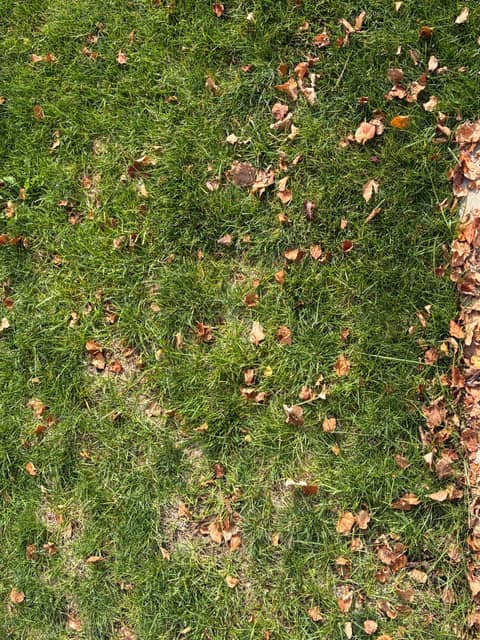
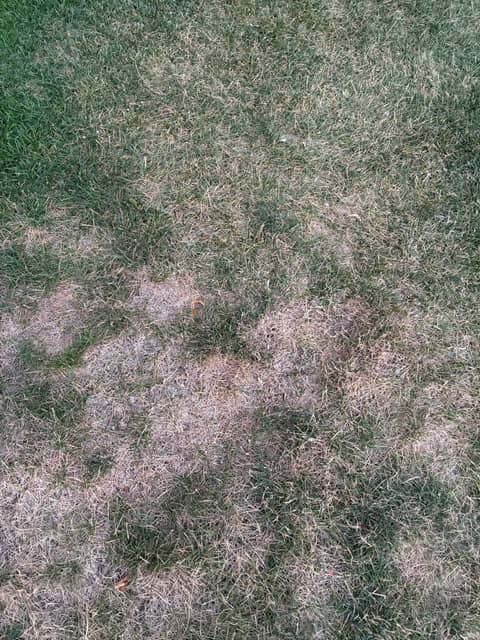
My own lawn in northern Utah had tan patches from May through July this year. By November most of them had filled back in. I never confirmed the cause, so the photos below show what the damage looked like, not a diagnosis.
What this guide is based on
The photos are from my Kentucky bluegrass lawn in northern Utah. The tests and causes come from USU Extension, listed at the end. I haven't run these tests on every problem here, so don't treat this as first-hand results.
This year, watering was the only thing I did about these patches. I watered 3 times a week from mid-May through August.
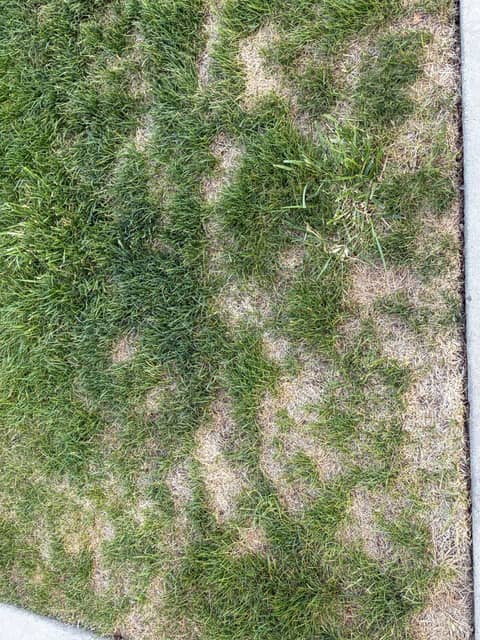
By November 5, the same area was mostly green, with a few thin spots left. I didn't treat it. That fits USU's note that drought-dormant grass recovers when temperatures cool,2 but it doesn't prove drought was the cause.
Step 1: Note where and when it appeared
The timing in this table is for northern Utah.
| What you see | Possible cause | What to check next |
|---|---|---|
| Brown along sidewalks, park strips, and lawn edges, often from late June | Drought stress | Screwdriver test, then sprinkler coverage |
| Brown areas that peel up or break off, often from mid-July | Billbugs or white grubs | Tug test |
| Damage from spring through fall, worst in August and September | Sod webworms | Look closely at the damaged area, or ask Extension |
| Circles or rings, sometimes with green grass in the center | Necrotic ring spot or summer patch | Lab sample |
| Moist, well-rooted grass that is still browning | Possible fungal disease | Lab sample |
Patterns overlap. USU notes that billbug damage is often mistaken for drought stress, and the two can occur together because billbugs are more abundant in dry soil.3 Poor soil moisture and improper mowing can also leave irregular brown patches that look like disease.4
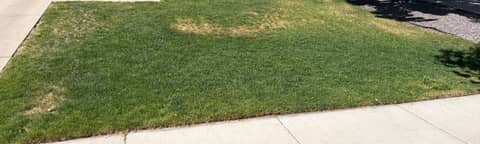
My patches didn't fit neatly. These photos are from May, before the late June start USU gives for drought stress,1 and the crescent below sits in the middle of the lawn.
Step 2: Push a screwdriver into the brown area
Push a long screwdriver into the soil in the brown area, then compare it with a green area.
- Hard to push in: the soil is dry. Go to step 4.
- Slides in easily: the soil has enough moisture, and drought probably isn't the problem. Go to step 3.
This test doesn't work on frozen ground. In winter, mark the areas and test them when the ground thaws.
Step 3: Tug on the grass
Pull upward on the brown grass.
- Lifts easily, like loose carpet: insects may be feeding on the roots.
- Breaks off at the crown, with hollow stems and sawdust-like waste inside: this suggests billbug larvae.3
- Well-rooted and moist, but still browning: it could be a fungal disease. Go to step 5.
Damaged areas usually need reseeding or new sod. USU says a preventive insecticide applied in late May or early June can help if you have had pest problems before,1 so it's a decision for next season. Follow the product label.
Step 4: Check your sprinkler coverage
If the soil is dry, find out whether water is reaching that spot. USU's test for one zone takes a few containers and a ruler:
- Put catch cans, like empty tuna cans, near each sprinkler head and halfway between heads, without blocking the spray.
- Run the zone until the cans have a measurable depth, and note the time.
- Measure each can.
- If the depths vary considerably, adjust or repair the heads and test again.
To find your zone's rate, divide the average depth in inches by the run time in minutes, then multiply by 60. That gives inches per hour. USU suggests 0.5 inch per watering for turf in Utah County, which takes 30 minutes at 1 inch per hour.5 Elsewhere, check with your local Extension office for your area's amount.
If water puddles or runs off, USU suggests splitting the time into shorter cycles about an hour apart.2 If you can't fix a dry spot, USU suggests watering it with a hose-end sprinkler once a week, or converting it to a waterwise bed.1
Dry doesn't always mean dead. USU says drought-dormant grass turns golden and recovers when temperatures cool and water returns. Keep foot traffic off it in the meantime.2
Step 5: Send a sample if you suspect disease
Don't diagnose necrotic ring spot from a photo. USU says some of its symptoms can come from other stresses, and it is often confused with other diseases.4 The disease attacks roots and crowns, so a sample is the reliable way to confirm it.
Your county Extension office may be able to help first. Most states also have a plant diagnostic lab that takes samples. In Utah, that's the Utah Plant Pest Diagnostic Lab. Check the lab's current instructions and fees before you send one.
If it is necrotic ring spot, avoid drought stress, reduce compaction by core aerating with clean equipment, and consider more resistant varieties when you reseed. Recovery is slow.4
What to avoid while you figure it out
USU warns against each of these while a lawn is stressed.1
- Weed killer in high heat: avoid broadleaf products in hot weather, especially those containing 2,4-D or dicamba.
- Overwatering: summer diseases are more likely in overwatered lawns and lawns with thick thatch.
- Heavy fertilizing: it increases pest and disease problems.
- Mowing too short: mow at about 3 inches, and remove no more than one-third of the blade at a time.2
Sources
Why Is My Lawn Turning Brown?, USU Extension, 2025
Basic Turfgrass Care, USU Extension
Billbugs in Turfgrass, USU Extension, 2022
Necrotic Ring Spot, USU Extension, 2008
Simple Sprinkler Performance Testing for Utah County, USU Extension