A weed you can't name is hard to control. Some weed killers kill broadleaf weeds and leave grass, some kill grasses, and pre-emergent products only stop seeds from sprouting.1
Utah State University (USU) Extension says positive identification is often critical to success,1 so identify the weed before you buy a product or pick a date to treat it.
This guide sorts weeds with two questions: is it a grass or a broadleaf, and is it an annual or a perennial? Then it compares 10 common lawn weeds and covers when to treat them. It is written for Utah. Elsewhere, check timing with your state's Extension office.
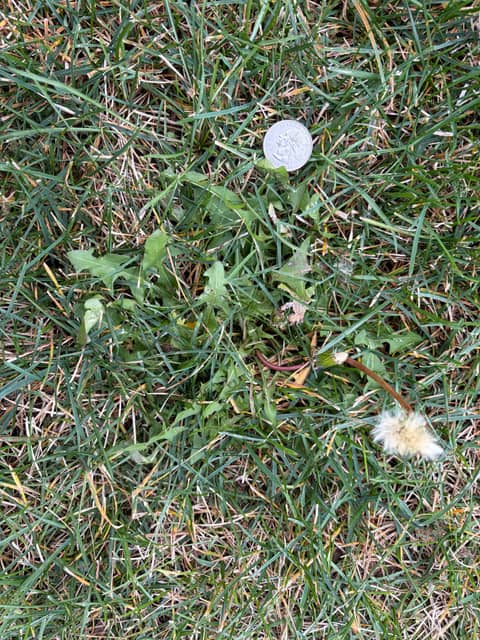
My lawn in northern Utah has several kinds of weeds. This guide includes photos of two: dandelions and a clump of what is probably tall fescue.
What this guide is based on
The identification clues and control guidance come mainly from USU Extension, with some identification clues from University of California and Colorado State University Extension. All are listed at the end. The photos are from my lawn. I have not tested these treatments unless I say so.
Step 1: Grass or broadleaf?
| Type | Look for | Examples |
|---|---|---|
| Grassy weed | Narrow leaves with parallel veins, fibrous roots | Crabgrass, annual bluegrass |
| Broadleaf weed | Wider leaves with a network of veins, often a taproot | Dandelion, clover, bindweed |
Be careful with grassy weeds. USU says tall fescue and other perennial weedy grasses are often confused with crabgrass, and the treatments differ.1
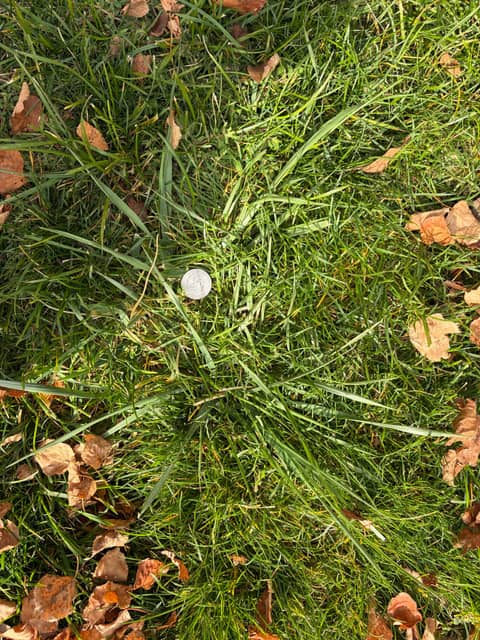
This clump in my lawn is probably tall fescue. Its blades are wider and coarser than the Kentucky bluegrass around it.
Step 2: Annual or perennial?
- Annuals grow from seed, mature, and die in less than a year. Stopping the seed from germinating is the main approach.
- Perennials come back from established plants. USU says they often need an herbicide.1
Step 3: Compare the plant
The clues come from USU's Lawn Weeds of Utah,2 except where another source is marked. The control suggestions come from USU's lawn weed control guide.1
| Weed | What to look for | What USU suggests |
|---|---|---|
| Dandelion | Rosette of deeply serrated leaves, a yellow flower on a hollow, leafless stalk, and a taproot with milky sap3 | Hand-dig minor infestations, including the taproot. Spray with a 3-way or 4-way product in early fall. |
| Broadleaf plantain | Rosette of oval, prominently veined leaves, rat-tail seed heads | Hand-dig, raise mowing height, and aerate compacted soil. Spray in early fall and spring. Expect repeat treatments. |
| White clover | Three leaflets, often with a whitish crescent, and round white to pale pink flower heads.4 Spreads by stems above and below ground | Increase fertility. Spray in early fall with a product containing triclopyr and MCPP. Expect repeat treatments. |
| Black medic | Three leaflets, trailing stems, small yellow flowers, black seed pods | Hand-dig before seed forms, water deeply, raise mowing height, and increase fertility. |
| Common mallow | Leaves like a geranium's,5 a long, fleshy, whitish taproot, pale flowers, and flat disc-shaped seed heads | Wet the soil and dig young plants, including the taproot. |
| Field bindweed | Arrowhead-shaped leaves5 with rounded tips and lobes, white to light pink flowers, and vining stems | Plan on repeated treatments over several years. |
| Prostrate spurge | Grows flat, milky sap, leaves sometimes with reddish-brown spots | Healthy turf outcompetes it. Hand-dig minor infestations. Post-emergent products are less effective. |
| Purslane | Fleshy, reddish leaves and stems, small yellow flowers | Healthy turf outcompetes it. Seedlings keep emerging, which makes post-emergent products less effective. |
| Crabgrass | Low stems that root at the joints, fingerlike seed heads, dies at the first hard frost | Apply pre-emergent in early spring, and again in mid-summer if needed. |
| Annual bluegrass | Low clumps of often yellowish-green, hairless blades.6 Seed heads almost always present. Dies back in hot, dry weather and thrives in moist shade | Apply pre-emergent in late summer. Selective control has narrow margins for error, so USU recommends a professional for extreme cases. |
For more species and photos, use USU's Common Weeds of the Yard and Garden. If you still can't tell, ask your county Extension office.
When to treat
USU gives this timing for Utah lawns.1
| Goal | Timing |
|---|---|
| Stop crabgrass and spurge from germinating | Early spring, before seeds germinate. Crabgrass begins to germinate within a few weeks of soil reaching about 50-55°F. |
| Treat living broadleaf weeds | Spring or early fall, while weeds are young, actively growing, and not yet flowering. |
| Treat perennial broadleaf weeds | Early fall can work well because the herbicide moves to the roots. |
Follow the label every time, and check these limits:1
- Heat: apply selective broadleaf products at 55-85°F in low wind. Above 85°F, they can vaporize and drift, sometimes for miles, and damage other plants.
- New seed: pre-emergent products also stop grass seed you want to grow. Don't use them where you have just seeded.
- Weed and feed: use it only for light infestations of young, mainly annual weeds.
The long-term fix
USU calls prevention, through good lawn care, the best practical approach to long-term weed control.1 Mow at 2.5 to 4 inches, water deeply and infrequently, test your soil before you fertilize, and aerate compacted soil.
You don't have to remove everything. USU notes that a few dandelions can be left, since they are a valuable early-spring plant for bees.1
Sources
Weed Control Options for Residential Lawns in Utah, USU Extension, 2015
Lawn Weeds of Utah, USU Extension, 2007
Dandelion, UC Statewide IPM Program, 2025
White Clover, UC Statewide IPM Program, 2025
Weed Descriptions, GardenNotes #352, Colorado State University Extension, 2015, reviewed 2025
Annual Bluegrass, UC Statewide IPM Program, 2025