A lawn that turns brown in fall might be warm-season grass going dormant on schedule, or cool-season grass under stress. Which type of grass you have also sets when to fertilize, seed, and aerate, because those dates differ between the two.
North Carolina State Extension says cool-season grasses grow best in spring and fall, while warm-season grasses grow best in summer, go dormant at the first heavy frost, and green up slowly in spring.1 So watch when your lawn grows and when it browns. That narrows it down before you look at a single leaf.
This guide covers how to tell the two types apart, first by when the grass grows and then by its leaves, which type to expect where you live, and when to seed, fertilize, and aerate each type in northern Utah. It is based on university Extension sources.
My lawn is Kentucky bluegrass, a cool-season grass, in northern Utah. I have no first-hand experience with the warm-season grasses here.
Identify your grass
Check when it grows
This table is from NC State's lawn chapter.1
| Cool-season | Warm-season | |
|---|---|---|
| Main growth | Spring and fall | Summer |
| Common lawn grasses | Kentucky bluegrass, tall fescue, fine fescues, perennial ryegrass | Bermudagrass, zoysiagrass, St. Augustinegrass, centipedegrass |
Brown doesn't prove a lawn is warm-season. Utah State University (USU) Extension says a Utah lawn can turn golden and go dormant in a drought, then recover as temperatures cool and water becomes available.2
Cool-season grasses: look at the leaves
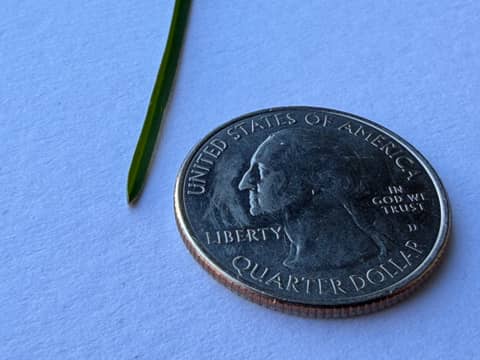
Start where the leaf blade joins the stem. Penn State Extension says this spot has a small piece of tissue called the ligule. On cool-season grasses it is a thin membrane, never a fringe of hairs. A fringe of hairs is common on most warm-season grasses and many weed grasses.3
Then look at a single blade, close up. This table is also from Penn State.3
| Grass | Blade | Tip | Growth |
|---|---|---|---|
| Kentucky bluegrass | One prominent mid-vein, dull underside | Boat-shaped | Spreads by rhizomes |
| Tall fescue | Many equal-sized veins, no dominant mid-vein | Pointed | Mostly bunches |
| Perennial ryegrass | Prominent mid-vein, glossy underside | Boat-shaped | Bunches |
| Fine fescues | Very narrow and folded, veins usually not visible | Boat-shaped | Bunches or rhizomes |
Warm-season grasses
NC State describes the main warm-season lawn grasses this way:1
- Bermudagrass: spreads by runners above and below ground, and can invade flower beds.
- Zoysiagrass: stiff leaves and very dense turf that feels like walking on a cushion. It grows more slowly than bermudagrass.
- St. Augustinegrass: very coarse leaves and medium to dark green color. It is the least cold-tolerant lawn grass, and seed isn't available, so it is planted as sod or other plant pieces.
USU names buffalograss and blue grama as warm-season grasses for northern Utah.4
Which should you expect in your area?
Check locally, because the answer depends on climate. USU's northern Utah calendar gives Kentucky bluegrass and the fescues as its examples of cool-season grass.4 In North Carolina, NC State says cool-season grasses are better adapted to the mountains and piedmont, and warm-season grasses do better farther east and south.1
If you still aren't sure, ask your county Extension office. Ask what kind of sample they want before you dig one up.
When to seed, fertilize, and aerate in northern Utah
Once you know your type, these dates come from USU's northern Utah calendar.4
| Cool-season | Warm-season | |
|---|---|---|
| Seed | Late summer is best | Spring or early summer |
| Fertilize | May, September, and November | June and July |
| Aerate | Early to mid-spring, or late summer to early fall | Early to mid-summer |
The grass type sets the season for each job, because USU times them to when the grass is actively growing. Your local weather sets when that season arrives, so these dates are for northern Utah in an average year. USU says to adjust them in unusually hot, cold, wet, or dry weather.4
For the rest of the year on a cool-season lawn, see the Utah lawn care calendar.
Sources
Extension Gardener Handbook: Lawns, NC State Extension, 2022
Basic Turfgrass Care, USU Extension, 2011
The Cool-season Turfgrasses: Identification, Penn State Extension, 2025
Northern Utah Turfgrass Management Calendar, USU Extension, 2017