Fertilizing, seeding, aerating, and weed control each have a season when they work best. At the wrong time, a job can do little or undo another one. For example, pre-emergent herbicide stops grass seed as well as weed seed.1
In November, Utah State University (USU) Extension says to make the last mow short and then apply a quick-release nitrogen fertilizer, because lawn roots absorb nutrients well in late October or early November.2
This guide covers a month-by-month table for cool-season lawns, such as Kentucky bluegrass and fescue, in northern Utah, then the two November jobs, then notes on each job through the year. It follows USU's northern Utah calendar, which covers counties including Salt Lake, Davis, Weber, Cache, and Utah.3 Southern Utah's season runs longer, so its dates differ.2
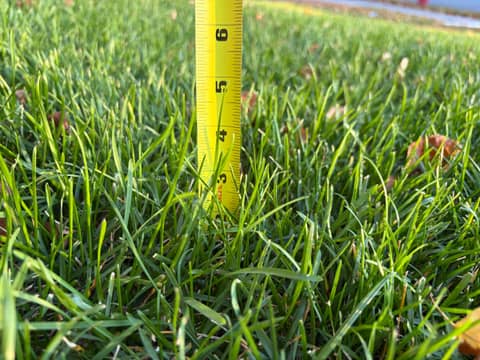
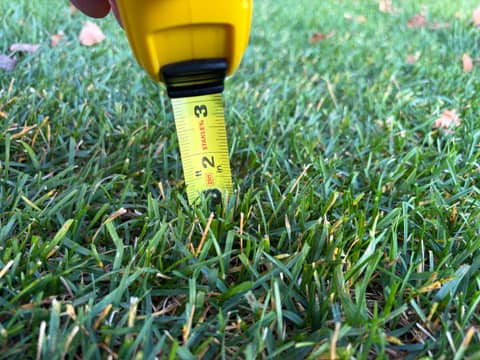
On my Kentucky bluegrass lawn in northern Utah, I did both jobs in the front yard on November 7. I lowered the mower until the grass measured about 1.5 inches, down from about 3 to 3.5 inches, and bagged the clippings. Then I spread a little over 4 pounds of IFA Fall & Winter Lawn Food (22-2-12) on the front yard and park strip, about 820 square feet, with a hand spreader. That is about 1.1 pounds of nitrogen per 1,000 square feet. I ran the sprinklers for about 5 minutes per station to water it in. The backyard was still wet, so I'll do it next week.
The year at a glance
This table follows USU's calendar, which is based on average weather.3 Adjust for an unusually hot, cold, wet, or dry year.
The watering intervals are for a normal year. In a drought, follow your city's or water district's watering restrictions first. In Utah, for a schedule based on this week's weather, check the Utah Division of Water Resources Weekly Lawn Watering Guide.4
| Month | Lawn tasks | Watering, if needed |
|---|---|---|
| March | Pre-emergent weed control | Usually off until spring startup |
| April | Start mowing when growth begins. Pre-emergent, aerate, seed, or overseed. | Every 6 days, if needed |
| May | Fertilize. Pre-emergent, broadleaf weed control, aerate, seed, or overseed. | Every 4 days, if needed |
| June | Broadleaf weed control. Second pre-emergent, if needed. | Every 3 days |
| July | Second pre-emergent, if needed. Don't apply post-emergent products above 85°F.1 | Every 2 days |
| August | Seed or overseed. Late summer is the best time to seed. | Every 3 days |
| September | Fertilize, aerate, seed, overseed, and control broadleaf weeds. | Every 6 days |
| October | Broadleaf weed control. Keep mowing while the grass grows. | Every 10 days, if needed, until shutdown |
| November | Last mow, in late October or November, then late-fall fertilizer2 | Off |
| December to February | No tasks on USU's calendar | Off |
USU's fall guide says the irrigation season generally runs April through October in northern Utah, and March through November in southern Utah.2
What to do in November
If you haven't done them yet:
- Last mow: keep mowing until the grass stops growing. For the final cut, USU's calendar says to go down to about 1.5 inches, to help avoid disease problems over winter and early spring.3 Its fall guide says 1.5 to 2 inches, and to remove the clippings.2
- Late-fall fertilizer: after the last mow, apply a quick-release nitrogen fertilizer at 1 pound of nitrogen per 1,000 square feet. USU says late October or early November works well, and that the exact timing depends on your location, grass species, and weather.2
The simplest way to get the amount right is to follow the rate on the bag. Most lawn fertilizer bags give pounds per 1,000 square feet, or say how many square feet the bag covers. My 22-2-12 bag says 5 pounds per 1,000 square feet. That supplies about 1.1 pounds of nitrogen, close to USU's 1 pound.
To check a bag against USU's rate, divide 100 by the first number on the bag. The answer is pounds of fertilizer per 1,000 square feet. For 22-2-12, 100 ÷ 22 is about 4.5 pounds. This works because the first number is the percent of nitrogen: 100 pounds of 22-2-12 holds 22 pounds of nitrogen. To do the math for your lawn size, use the lawn fertilizer calculator.
Each job through the year
These notes cover the rest of the year. For when to do each job, see the table above.
Mowing
During the growing season, mow at 2.5 to 3 inches or taller. Ideally, remove no more than one-third of the blade at once: if the grass is 4 inches high, mow no lower than 3 inches. Leave clippings on the lawn.3 The last mow of the year is the exception: go down to about 1.5 inches and remove the clippings, as described above.
Fertilizing
USU recommends 2 to 4 pounds of nitrogen per 1,000 square feet a year, at 1 pound per application. Its calendar marks May, September, and November for cool-season lawns.3
Test your soil every 2 to 3 years for phosphorus and potassium advice. USU County Extension offices have kits and instructions.3
Watering
Water early in the morning, and avoid windy times of day. Check the system monthly for leaks and for broken or clogged heads.3
The intervals in the table don't say how long to run each zone. To see how much water your system puts down, set out catch cans, like empty tuna cans, as in the sprinkler check in How to diagnose a brown or thinning Kentucky bluegrass lawn.
Aerating
Core aerate during active growth, in early to mid-spring or late summer to early fall. For best results, make a second pass at 90 degrees to the first. If you aerate in spring, consider pre-emergent where weeds have been a problem.3
Seeding
You can seed from mid-spring to early fall, but USU says late summer is best in northern Utah. Warm soil speeds germination, and there is less annual weed pressure. Allow 4 to 6 weeks before the expected first frost.3
Don't use pre-emergent where you plan to seed, because it also kills or suppresses grass seed.1
Weed control
Apply pre-emergent before weed seeds germinate, in early to mid-spring. Treat broadleaf weeds with a post-emergent product while they are actively growing, and follow the label.3 USU's weed control guide says not to apply post-emergent products above 85°F.1
To work out which weeds you have, see the lawn weed identification guide for Utah.
Sources
Weed Control Options for Residential Lawns in Utah, USU Extension, 2015
How Do I Take Care of My Lawn in Utah in the Fall?, USU Extension, 2026
Northern Utah Turfgrass Management Calendar, USU Extension, 2017
Weekly Lawn Watering Guide, Utah Division of Water Resources, 2026