Kentucky bluegrass mowed short can thin out, brown in summer heat, and let weeds in. Mowed too tall, it can have its own problems. And the numbers on a mower's height lever don't tell you how tall the grass ends up.
Utah State University (USU) Extension says to keep cool-season lawns, such as Kentucky bluegrass, at least 2.5 to 3 inches tall during the growing season, or higher if your mower allows.1 Its basic care fact sheet says taller grass grows deeper roots, which can reach water deeper in the soil during hot, dry periods.2
This guide covers the height to aim for, why short grass struggles, how often to mow to stay at that height, and how to measure what your mower cuts. The last section shows how high my mower's deck sits at each of its five settings.
I have a Kentucky bluegrass lawn in northern Utah. In summer I mow it once a week, at the third or fourth of my mower's five height settings. Parts of the lawn are shaded, and I mow them at the same setting as the rest.
The height to aim for
Colorado State University (CSU) Extension gives the same range for every lawn species, 2.5 to 3 inches.3 USU says 2.5 to 3 inches or higher.1
The last mow of the year is the exception. USU says to cut it to about 1.5 to 2 inches.1 The last mow guide covers why.
Why short grass struggles
CSU says mowing lower than 2 inches can reduce drought and heat tolerance, because it leads to shallow roots and limits photosynthesis. It also raises the risk of weeds moving in.3
Taller isn't always better. CSU says mowing too high may encourage insects, diseases, and weeds.3 USU's fact sheet says shaded areas can be mowed higher than sunny ones, to give the grass more leaf to collect light.2
How often to mow
The height you aim for is what the grass should look like right after mowing. Between mows it grows taller, and how much you cut off at once matters too.
CSU says to mow often enough that you never remove more than one-third of the grass height at a time.3 To keep grass at 3 inches, mow before it passes 4.5 inches.
For bluegrass, CSU says that can mean mowing every 3 to 4 days during fast spring growth, and only every 7 to 10 days when heat, drought, or cold slows growth. If you have to skip a mow, raise the mower for the next one so you don't cut off too much at once.3 USU says to bring an overgrown lawn down gradually over several mows.2
How to measure what your mower cuts
Many mowers mark their height settings with numbers or notches, not inches. To find the real height:
- Mow a strip at your usual setting.
- Stand a tape measure or ruler in the cut grass and read where the tops of the blades reach.
- Raise or lower the setting and repeat until you get the height you want.
Write down the setting once you find it, so you don't have to measure again.
What I found on my mower
My mower has a height lever at each wheel, with five settings. For each setting, I moved all four levers to the same notch, then measured from the pavement to the bottom edge of the deck, once just behind a front wheel and once just in front of a back wheel.
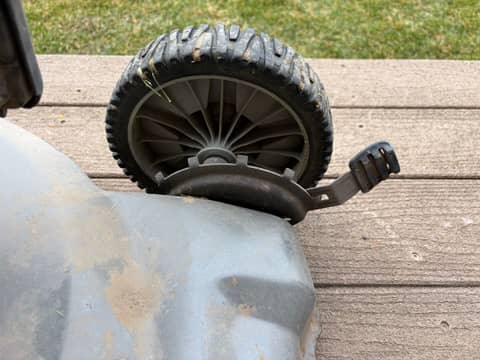
| Setting | Front of deck | Back of deck |
|---|---|---|
| 1 (lowest) | about 3/4 in | about 1 in |
| 2 | about 1 1/8 in | about 1 3/8 in |
| 3 | about 1 7/8 in | about 2 in |
| 4 | about 2 3/4 in | about 3 in |
| 5 (highest) | about 3 3/4 in | about 3 7/8 in |
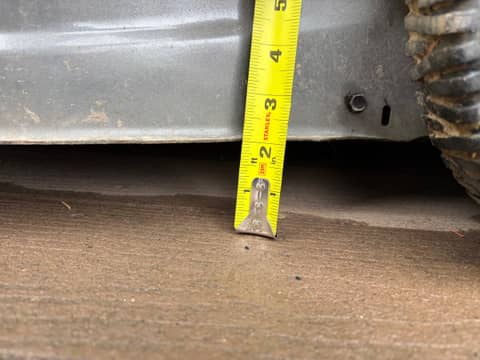
The settings aren't evenly spaced. Going from setting 1 to 2 raises the deck about 3/8 inch, but each step from 3 to 5 raises it about 7/8 inch or more. The front of the deck sits a little lower than the back at every setting.
The deck edge is not the grass height. The blade spins inside the deck, above the bottom edge, so it cuts the grass taller than these numbers. Use them to compare settings, and measure the cut grass to find the real height.
In summer I mow at setting 3 or 4. The blade cuts above the deck edge, so at setting 4 my grass ends up at least about 2 3/4 inches tall, within or above USU's 2.5 to 3 inches. At setting 3 the deck edge sits about 2 inches up, so the grass could end up shorter than 2.5 inches.
Sources
How Do I Take Care of My Lawn in Utah in the Fall?, USU Extension, 2026
Basic Turfgrass Care, USU Extension, 2011
Basic Turf Management, GardenNotes #551, Colorado State University Extension, 2012, reviewed 2025