All season you mow tall, at 2.5 to 3 inches or more. Then the last mow of the year comes, and the advice changes. Long grass left over winter can fall over under snow and mat down, and a lawn that goes into winter that way is more likely to get snow mold.
Utah State University (USU) Extension says to cut the last mow to about 1.5 to 2 inches and remove the clippings, because a shorter final cut can reduce disease problems over winter and early spring and keeps long grass from falling over under snow.1
This guide covers when to make the last mow, how to get there without cutting off too much at once, and when to stay taller instead. The last section shows my front yard and backyard before and after.
I have a Kentucky bluegrass lawn in northern Utah. I mowed the front yard on November 7 and the backyard on November 10, from about 3 inches down to about 1.5 inches, with the bag on.
When to make the last mow
USU says to keep mowing while the grass is still growing.1 The last mow is the one after growth stops. The University of Minnesota (UMN) says the same, and that mowing until the grass stops growing helps reduce snow mold and winter damage.2
To tell when growth has stopped, watch how fast the grass grows back. A 2017 USU turf advisory describes the point as when growth has stopped or slowed so much that the lawn no longer needs mowing, while the grass is still green.3 One way to check is to measure the grass with a tape measure right after a mow, then again a week later. If it has barely grown, the next mow can be the last.
Make the last mow before you fertilize. USU says to apply a quick-release nitrogen fertilizer after the last mowing.1 The late-fall fertilizer guide covers that step.
Don't cut off too much at once
USU also says to avoid cutting more than one-third of the blade at one time.1 Going from 3 inches to 1.5 inches cuts off half. USU doesn't say how to fit the two rules together.
UMN says that if you lower the mowing height before winter, mow several times at the new height, not just the last time.2 One way to follow both: lower the mower a notch on each of the last two or three mows, so no single cut takes more than a third.
When to stay taller
UMN disagrees with USU on height. It suggests keeping your usual fall height, because cutting too short can stress the grass more than snow mold or voles would injure it. If your lawn is taller than 3 inches, it suggests bringing it down to 3 inches. It suggests cutting shorter only if you have had snow mold before, or keep your grass long in fall.2
USU's advice is written for Utah, so I follow it.
USU also says snow mold is usually worse where snow stays on the lawn longer, so avoid piling shoveled snow on shaded parts of the lawn.4
How to measure the height
Stand a tape measure or ruler in the grass and read where the tops of the blades reach. Do it before and after you mow, so you know what you actually cut to.
What I did
I don't know which height setting on my mower gives 1.5 inches. I lowered it until the tape measure read about right.
In the front yard on November 7, the grass was about 3 to 3.5 inches tall. I cut it to about 1.5 inches in one pass, with the bag on.
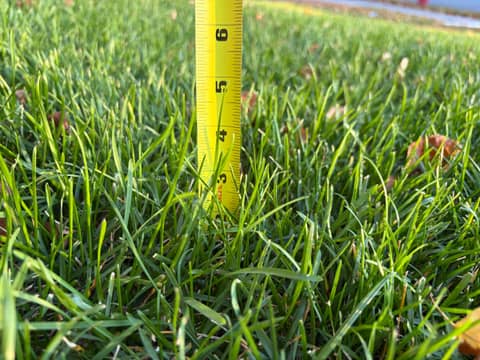
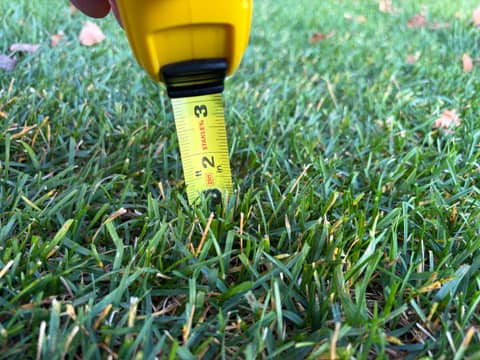
In the backyard on November 10, I did the same, from about 3 inches to about 1.5 inches.
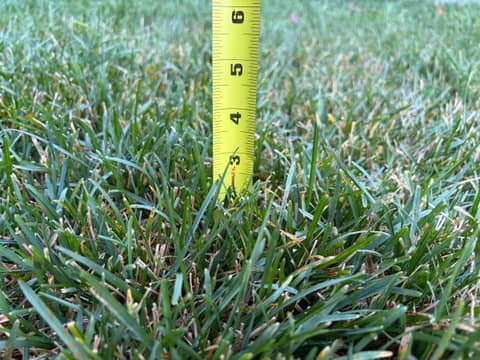
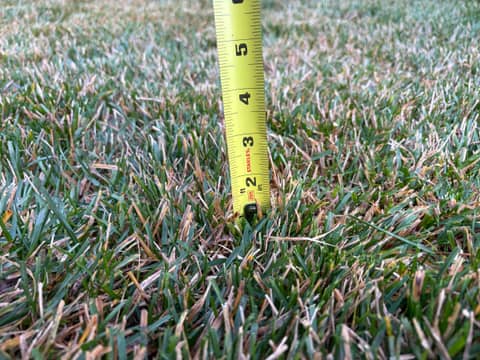
Both cuts took off about half the blade at once, more than the one-third USU suggests. I won't know until spring how the lawn came through the winter.
Sources
How Do I Take Care of My Lawn in Utah in the Fall?, USU Extension, 2026
Q & A: Fall Lawn Care, University of Minnesota Turfgrass Science, 2017
Turfgrass IPM Advisory, Fall 2017, USU Extension, 2017
Ask an Expert: Final Fall Pruning and Projects, USU Extension, 2020