By November the grass has nearly stopped growing, so fertilizing it can seem pointless. You may also wonder whether it is too late, or whether a fall bag is worth buying.
Utah State University (USU) Extension says yes, apply one quick-release nitrogen fertilizer after the last mow, because lawn roots absorb nutrients well in late October or early November. USU says this helps the lawn green up earlier the next spring and gives it more drought tolerance the following summer.1
This guide covers why late-fall fertilizer works, when to apply it, what kind and how much, how to apply it, and when to skip it. The last section shows the bag I used and how much I spread.
I have a Kentucky bluegrass lawn in northern Utah. I fertilized the front yard and park strip on November 7 and the backyard on November 10, both right after the last mow, with IFA Fall & Winter Lawn Food (22-2-12).
Why it works
A 2017 USU turf advisory, written for athletic fields, explains the reasons. Late-fall fertilizer adds to the carbohydrate reserves stored in the grass stems and rhizomes. Those reserves help the grass resist winter injury and handle stress the next spring and summer. A late-fall feeding also pushes less leaf growth in spring than the same amount applied in spring, so the reserves last longer.2
The same advisory says late-fall fertilizer can improve early spring color and may let you skip the early spring feeding, though you will still need one in mid to late spring.2
When to apply it
USU's 2017 advisory gives three conditions:2
- Growth has stopped or slowed so much that the lawn no longer needs mowing.
- The grass is still green.
- The soil is not frozen.
In northern Utah, USU says that usually happens in November. In southern Utah it may be late November or even early December.2 USU's 2026 fall guide says late October or early November, and that the exact timing depends on your location, grass species, and weather.1
Colorado State University (CSU) Extension adds a margin: apply the last fall nitrogen at least two to three weeks before the ground freezes.3
The simplest way to time it is to fertilize right after the last mow, as USU's fall guide says.1 The November lawn care guide covers the last mow.
What kind and how much
USU says Utah lawns most often need nitrogen. Don't assume yours needs phosphorus or potassium. Those are needed less often, and a soil test will tell you.1
For late fall, USU recommends a quick-release nitrogen fertilizer at 1 pound of nitrogen per 1,000 square feet.1 Its 2017 advisory gives 1 to 1.5 pounds of mostly soluble nitrogen, a range meant to avoid leaching, runoff, and too much growth in spring.2
To check whether a bag is quick-release, read the guaranteed analysis on the back, which lists where the nitrogen comes from. USU names urea and ammonium sulfate as quick-release forms. Most slow-release lawn fertilizers use urea with a coating, such as sulfur or plastic.4
To turn a bag's rate into pounds of nitrogen, multiply the pounds of fertilizer by the first number on the bag, as a percent. Five pounds of a 22-2-12 fertilizer holds 5 × 0.22 = 1.1 pounds of nitrogen. To work out how much to spread on your own lawn, use the lawn fertilizer calculator.
How to apply it
My bag's directions say to apply it to a dry lawn and water it in soon after. Check your own bag, because directions differ between products.
If your sprinklers are already shut off for winter, use a hose, or turn the system back on for that one watering and shut it off again.
Keep granules off driveways, sidewalks, and streets. CSU says fertilizer spread onto hard surfaces can wash into lakes and streams through storm drains.3 Sweep or blow any stray granules back onto the lawn.
When to skip it
- The ground is frozen. USU says never to apply fertilizer to frozen soil, because it can run off.2
- The grass has already gone brown for winter. USU's timing assumes the grass is still green.2
- Your soil is very sandy. CSU says not to fertilize very sandy soil after late September, because nitrogen can leach into groundwater over winter.3 USU suggests considering slow-release fertilizer on sandy soil.2
What I did
I used IFA Fall & Winter Lawn Food, a 25-pound bag of 22-2-12.
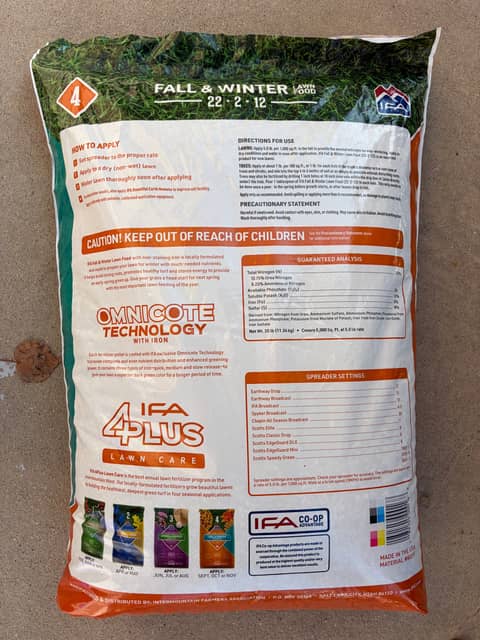
Here is what the back of the bag says, and how it compares with USU's advice:
| On the bag | What it means |
|---|---|
| 22% total nitrogen: 13.75% urea, 8.25% ammoniacal, from urea, ammonium sulfate, and ammonium phosphate | No coated or slowly available nitrogen is listed, so it is quick-release. That matches USU's advice for late fall. |
| 2% phosphate, 12% potash | Small amounts of phosphorus and potassium. I haven't had a soil test, so I don't know whether my lawn needs them. |
| 3% iron | The bag's "slow release" wording refers to the iron coating, not the nitrogen. |
| 5 pounds per 1,000 square feet | 1.1 pounds of nitrogen per 1,000 square feet, close to USU's 1 pound. To hit 1 pound exactly, use about 4.5 pounds. |
| Apply to a dry lawn, water in soon after | I did both. |
I weighed out the amount for each area, put it in a hand spreader, and walked the lawn until the spreader was empty.
| Area | Date | Size | Fertilizer | Nitrogen per 1,000 sq ft |
|---|---|---|---|---|
| Front yard and park strip | November 7 | About 820 sq ft | A little over 4 pounds | About 1.1 pounds |
| Backyard | November 10 | About 1,259 sq ft | 6.3 pounds | About 1.1 pounds |
I measured both areas with Google Maps. I watered in the front yard with the sprinklers. For the backyard, I had already shut off the sprinkler water, so I turned it back on to water in the fertilizer, then shut it off again.
Sources
How Do I Take Care of My Lawn in Utah in the Fall?, USU Extension, 2026
Turfgrass IPM Advisory, Fall 2017, USU Extension, 2017
Basic Turf Management, GardenNotes #551, Colorado State University Extension, 2012, reviewed 2025
Lawn Fertilizers for Cool Season Turf, USU Extension, 2012